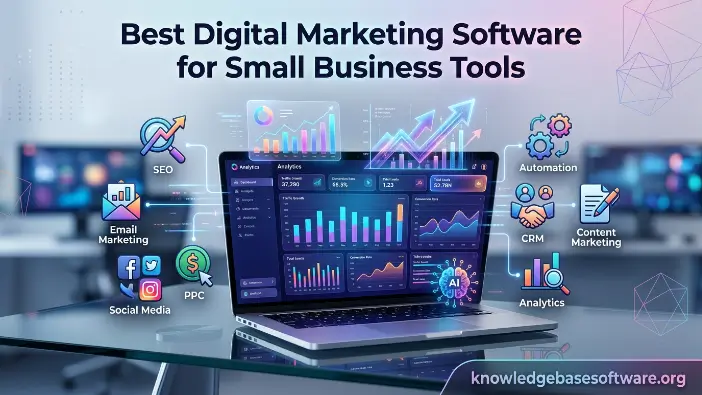
Welcome to knowledgebasesoftware. In today’s highly competitive digital landscape, digital marketing software for small businesses is no longer optional; it has become a vital part of achieving sustainable growth. Small businesses now compete not only with local rivals but also with major brands that have larger budgets, bigger teams, and advanced marketing systems. Without the right tools, handling campaigns, tracking performance, and keeping customers engaged consistently can become very difficult.
Modern marketing automation software has transformed how small businesses handle marketing by converting complex tasks into simple, automated, and manageable processes. Instead of manually sharing social media posts, sending emails one by one, or tracking customer interactions through spreadsheets, business owners can rely on intelligent systems to handle these activities efficiently and accurately. This shift allows entrepreneurs to spend more time on strategy, customer experience, and business development rather than repetitive marketing duties. In addition, using digital marketing software for small businesses encourages more data-driven decision-making. Businesses can track customer behavior, measure campaign performance, and modify their strategies in real time. This increases overall marketing efficiency while also improving return on investment by delivering the right message to the right audience at the right time.
Why Small Businesses Need Digital Marketing Software
In today’s constantly evolving digital economy, digital marketing software for small businesses has become an important factor in supporting survival and growth. Small businesses operate in competitive environments where customers expect fast responses, personalized communication, and a dependable online presence. Without organized systems, managing marketing tasks manually can quickly become stressful and often leads to missed opportunities. By adopting marketing automation, businesses can streamline their processes, improve productivity, and maintain a consistent brand presence across multiple channels.
Limited time and resources
Small businesses typically operate with small teams, limited budgets, and many responsibilities handled by the same employees or sometimes one person. This makes managing every marketing task manually difficult, especially when activities such as email campaigns, content publishing, and customer follow-ups require continuous attention. As a result, important marketing tasks may be delayed or completed inconsistently.
This is where digital marketing software for small businesses provides a useful solution. It allows owners to use small business tools that automate repetitive tasks, helping them save valuable time and reduce the manual effort involved. By improving efficiency, businesses can focus more on strategy and customer relationships rather than everyday marketing execution.
Need for automation and efficiency.
Modern marketing requires speed, accuracy, and consistency, which can be challenging to maintain without automation. Many small businesses struggle to communicate with customers regularly or track campaign performance effectively. Manual processes can often lead to errors, delays, and missed chances to engage with customers.
Using marketing automation systems, businesses can schedule campaigns, trigger automated emails, and manage customer journeys with little ongoing supervision. This improves operational efficiency and ensures marketing activities continue running consistently. As a result, businesses can achieve better performance with fewer resources while delivering a professional and consistent customer experience.
Competing with larger businesses
Large organizations often dominate their markets because they have significant budgets and skilled marketing teams. However, small businesses can still compete effectively by using smart digital tools. Without technology, keeping pace with the scale and precision of larger competitors can be extremely challenging.
With digital marketing software for small businesses, smaller companies can benefit from features such as analytics, automation, and audience targeting. These capabilities support cost-effective marketing strategies that help small businesses reach the right customers at the right time. By using data-driven insights and automated systems, they can compete more strategically rather than relying only on the size of their budget.
Read Also: marketing calendar software.
Key Features to Look for in Marketing Software
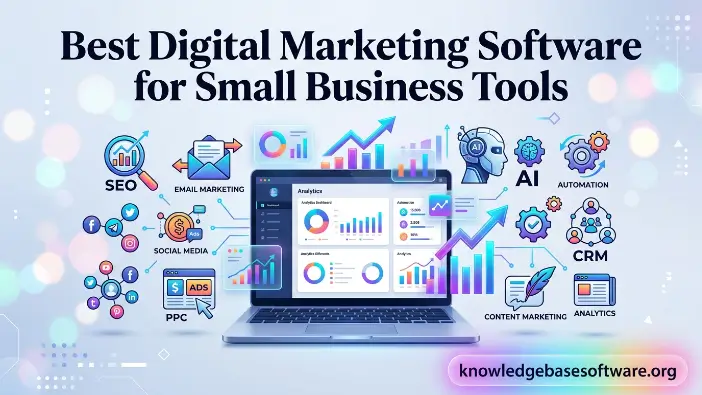
Choosing the right digital marketing software for a small business requires a strong understanding of the key features that directly affect performance, productivity, and long-term growth. Not every platform offers identical capabilities, so businesses should focus on tools that effectively support their marketing goals. The most useful solutions combine automation, customer management, and data insights in one system, helping businesses reduce manual work while achieving better results. Modern email marketing platforms and integrated systems are designed to simplify complex marketing tasks and deliver measurable outcomes through centralized management.
Email marketing automation
Email marketing automation is among the most useful features of any digital marketing software for small businesses because it allows businesses to reach customers at the right time without relying on manual effort. Automated workflows can send welcome messages, promotional offers, and follow-up emails based on user actions. This ensures consistent communication and helps businesses effectively nurture leads over time.
With advanced email marketing platforms, businesses can segment audiences, personalize messages, and significantly increase engagement rates. Instead of sending identical generic emails to every customer, automation enables targeted communication that can improve conversions and strengthen customer relationships.
CRM (Customer Relationship Management)
A CRM system plays an important role in organizing customer details, tracking interactions, and building stronger relationships over time. It allows businesses to store customer information in one central place, making it easier to understand purchasing patterns and communication records. This helps support more personalized and effective marketing approaches.
Modern CRM tools included in digital marketing software for small businesses allow teams to automate lead tracking and sales follow-ups. By keeping information centralized, businesses can improve cooperation between marketing and sales teams, supporting stronger customer retention and higher conversion rates.
Social media scheduling tools
Managing multiple social media accounts manually can take considerable time and may lead to inconsistent posting. Social media scheduling tools solve this problem by allowing businesses to plan, schedule, and publish content in advance. This makes it easier to maintain a regular online presence across platforms such as Facebook, Instagram, and LinkedIn.
These tools can also identify suitable posting times to support better engagement while reducing the daily pressure of content management. Within digital marketing software for small businesses, scheduling features help companies maintain brand visibility while focusing on other essential responsibilities.
Analytics and reporting
Analytics and reporting features are important for understanding how well marketing campaigns are performing. They provide useful data about website traffic, conversion rates, customer behavior, and overall campaign outcomes. Without dependable data, businesses may struggle to make informed marketing decisions.
A reliable analytics dashboard included in digital marketing software for small businesses allows teams to track key performance indicators in real time. This helps businesses quickly recognize successful activities and identify areas that need improvement, supporting better ROI from marketing efforts.
SEO and content optimization tools
SEO and content optimization tools help businesses improve search engine visibility and attract organic traffic. These features support tasks such as keyword research, content suggestions, and competitor analysis, helping businesses create content with stronger ranking potential.
By using built-in optimization features, businesses can better align content strategies with search intent and gradually improve search rankings. Within digital marketing software for small businesses, SEO tools help ensure that marketing efforts remain consistent while reaching the right audience.
Types of Digital Marketing Software
Knowing the different types of digital marketing software for small businesses is important when choosing tools that match specific goals and budget requirements. Each category serves a particular purpose, from managing customer relationships to improving online visibility and generating leads. Instead of relying on one solution, many businesses use several tools together or select integrated platforms to manage different marketing activities efficiently. This approach improves the use of online marketing tools while giving businesses greater control over campaigns and customer engagement strategies.
All-in-one marketing platforms
All-in-one marketing platforms combine features such as email marketing, CRM, automation, analytics, and social media management within a single system. These platforms make marketing operations easier by reducing the need for multiple separate tools. For small businesses, this can provide simpler implementation, better coordination, and improved efficiency across marketing channels.
With digital marketing software for small businesses, all-in-one solutions keep data and workflows connected in one place. This allows businesses to manage campaigns more efficiently while reducing expenses associated with using multiple marketing automation tools. As a result, teams can devote more time to strategy rather than repeatedly switching between platforms.
Email marketing tools
Email marketing tools are specifically designed to help businesses create, send, and manage email campaigns. They support subscriber list management, newsletter creation, and automated customer communication. These tools are especially useful for nurturing leads and maintaining long-term customer relationships.
Within digital marketing software for small businesses, standalone email solutions offer simplicity and flexibility. Many can integrate with email marketing platforms and CRM systems, allowing businesses to create targeted campaigns that improve engagement and conversion rates.
Social media management tools
Social media management tools allow businesses to schedule posts, track interactions, and manage multiple social media accounts from one dashboard. These tools are useful for maintaining a consistent brand presence across platforms such as Instagram, Facebook, and LinkedIn. They also reduce time requirements by automating publishing schedules and tracking performance.
When integrated with digital marketing software for small businesses, these tools improve social media scheduling efficiency and help maintain regular communication with audiences. Businesses can plan content, analyze engagement patterns, and adjust strategies using real-time insights.
SEO and content marketing tools
SEO and content marketing tools focus on improving search engine rankings and increasing content visibility. They support keyword research, content planning, competitor analysis, and on-page optimization. These features are important for attracting organic visitors and building stronger brand awareness.
Within digital marketing software for small businesses, SEO tools support stronger content optimization strategies. By analyzing search trends and performance information, businesses can create content that reflects user intent and improves long-term search visibility.
Lead generation software
Lead generation software helps businesses attract and collect potential customers through forms, landing pages, and pop-ups. These tools are designed to convert website visitors into qualified leads by collecting contact information and tracking user activity. They play an important role in building a strong sales pipeline.
Within digital marketing software for small businesses, lead generation tools can integrate with CRM tools and automation systems to simplify follow-up processes. This helps prevent potential customers from being missed while allowing leads to be nurtured through targeted marketing campaigns.
Best Digital Marketing Software Options for Small Businesses
Choosing the right digital marketing software for a small business involves more than selecting popular tools; businesses must match software capabilities with their needs, budget limitations, and future growth objectives. Every business operates at a different stage, so the suitable solution may range from simple, affordable marketing software for beginners to advanced systems designed to manage complete marketing ecosystems. The right platform can improve efficiency, simplify workflows, and strengthen customer engagement across multiple channels. Modern online marketing tools are also built to scale, allowing businesses to start with basic requirements and gradually upgrade without fully replacing their platforms.
Budget-friendly tools
Budget-friendly tools are designed for startups and small businesses that need essential marketing features without making a major financial investment. These solutions typically offer basic email campaigns, simple automation, and limited social media scheduling features. They are usually easy to use and require minimal technical knowledge, making them suitable for beginners.
Within the digital marketing software for small business category, budget-friendly options such as Mailchimp (free plan), Canva for marketing content, and Buffer for scheduling are commonly used. These affordable marketing software solutions help businesses maintain an active digital presence while keeping costs manageable. They are especially useful for new businesses testing marketing strategies or operating with limited budgets.
Mid-range scalable platforms
Mid-range scalable platforms offer a balance between affordability and advanced functionality. These solutions often include CRM integration, marketing automation, detailed analytics, and increased customization. They are suitable for growing businesses that need greater control over customer engagement and campaign performance.
Within digital marketing software for small businesses, platforms such as ActiveCampaign, Zoho CRM, and Sendinblue are notable choices in this category. These online marketing tools allow businesses to expand marketing operations efficiently while managing expenses. They are particularly useful for companies with an established customer base that want to improve conversions through automation and data-based strategies.
Advanced all-in-one solutions
Advanced all-in-one solutions offer comprehensive platforms that combine features such as CRM, email marketing, SEO, analytics, and automation within one system. These tools are designed for businesses that want to manage their complete marketing operations through a centralized dashboard.
Within the digital marketing software for small businesses market, HubSpot is one of the most recognized platforms in this category, along with tools such as Salesforce Marketing Cloud. These online marketing tools provide enterprise-level automation, advanced reporting, and detailed customer insights, making them suitable for fast-growing or established businesses that need a powerful marketing infrastructure.
Overview of popular tools (Mailchimp, HubSpot, etc.)
Popular tools within the digital marketing software for small business ecosystem include Mailchimp, HubSpot, ActiveCampaign, Zoho CRM, Buffer, and SEMrush. Each platform has a specific focus. Mailchimp specializes in email marketing, HubSpot offers an all-in-one system, SEMrush focuses on SEO optimization, and Buffer specializes in social media scheduling.
These affordable marketing software solutions and premium platforms are widely used because they offer flexibility and scalability. Businesses can choose tools based on their needs, whether they require email automation, lead generation, SEO improvements, or complete marketing management.
Pros and use cases for each category
Each category of digital marketing software for small businesses offers different advantages depending on business goals and development stage. Budget-friendly tools help startups establish an online presence quickly without major financial pressure, while mid-range platforms support growth through automation and enhanced analytics. Advanced solutions provide broader integration for businesses that want to bring their marketing operations together in one system.
In practical use, online marketing tools help businesses improve productivity, reduce manual workloads, and increase ROI through better targeting and automation. Choosing a suitable category allows businesses to save time and money while building a scalable and sustainable marketing system for continued success.
How to Choose the Right Marketing Software
Selecting the right digital marketing software for a small business is an important decision that directly affects marketing efficiency and the ability to reach customers effectively. With many platforms offering different features, pricing models, and capabilities, businesses should carefully evaluate their needs before choosing a solution. The goal is to invest in marketing automation software that addresses current requirements while supporting future growth without introducing unnecessary complexity or costs.
Budget and pricing considerations
Budget is often the first factor small businesses consider when choosing digital marketing software for a small business. Prices can vary significantly, from free basic plans to premium subscriptions intended for enterprise-level users. Businesses should examine the features available at each price level and determine whether they support their marketing goals.
When comparing available solutions, businesses should assess different cost-effective marketing options to make sure they receive the best possible value from their investment. Less expensive tools may seem attractive at first, but they might lack advanced features such as automation, analytics, or CRM integration that can become important as the business grows.
Ease of use for beginners
Ease of use is an important factor when selecting digital marketing software for small businesses, especially for teams with limited technical expertise. A simple and intuitive interface allows users to learn the platform quickly, launch campaigns, and manage regular marketing tasks without extensive training.
Many small business tools are designed for beginners and offer drag-and-drop builders, ready-to-use templates, and guided workflows. Choosing user-friendly software reduces onboarding time and allows marketing activities to start quickly without unnecessary confusion or delays.
Integration with other tools
Integration capabilities play an important role in the effectiveness of digital marketing software for small businesses. Most businesses depend on multiple systems, including websites, payment platforms, and social media services, so marketing software should connect smoothly with these tools.
Effective CRM tools and marketing platforms allow data to move easily between different systems, improving workflow efficiency and reducing manual data entry. This helps keep customer information consistent across platforms while supporting more accurate targeting and better decision-making.
Scalability for future growth
Scalability is an important factor when selecting digital marketing software for a small business, as businesses need solutions that can grow with them. A platform that meets current needs should also support future expansion without requiring the business to replace its entire system.
Many marketing automation software platforms offer scalable features, including advanced analytics, additional user access, and enhanced automation workflows. Considering future growth from the beginning can help businesses avoid costly migrations later and make the transition smoother as operations expand.
Common Mistakes to Avoid
Many businesses experience problems with digital marketing software for small businesses, not because the tools are ineffective, but because they are not implemented strategically. Poor setup, inadequate planning, and inconsistent use can lead to wasted resources and unsatisfactory results. When businesses do not understand how to use marketing automation software effectively, they miss opportunities to improve efficiency, simplify workflows, and strengthen customer engagement. Most of these challenges can be avoided through proper planning, training, and a clearly defined marketing strategy.
Common Mistakes to Avoid
- Using too many tools instead of selecting one integrated platform can create confusion, cause data loss, and make overall marketing workflow management less efficient.
- Ignoring automation features and continuing to complete tasks manually wastes valuable time and reduces consistency in customer communication and daily engagement.
- Failing to define clear marketing goals before choosing software can create poor alignment between business needs and the digital tools selected.
- Making workflows unnecessarily complex through too many automation steps can make campaigns more difficult to manage, troubleshoot, and optimize over time.
- Failing to properly track analytics limits data-driven decision-making and reduces the ability to improve campaign results and marketing return on investment.
- Choosing software mainly because of its price instead of its features can lead to limited functionality and inadequate scalability for future business growth.
- Failing to properly connect CRM systems can create fragmented customer data and missed opportunities for personalized marketing and stronger customer relationships.
- Overlooking training and onboarding can lower team productivity and cause available software features and marketing capabilities to remain underused.
- Ignoring mobile optimization features can result in weaker campaign performance and reduced engagement from users accessing content through smartphones and tablets.
- Failing to regularly update and optimize the system can lead to outdated strategies, declining performance, and missed opportunities in the competitive digital marketing environment.
Step-by-Step Setup for Small Businesses
Setting up digital marketing software for a small business properly from the start is important for achieving consistent results and avoiding unnecessary work. A structured setup ensures that every part of the system works together effectively, from customer tracking to campaign execution. Instead of using tools without a clear plan, businesses should follow an organized process that connects marketing automation software capabilities with long-term business goals. This structured approach improves efficiency, reduces errors, and helps create a scalable digital marketing setup that supports ongoing growth.
Define your marketing goals.
The first step in setting up digital marketing software for a small business is defining clear marketing goals. Without specific objectives, it becomes difficult to measure success or select suitable strategies. Goals may include increasing website traffic, generating leads, building brand awareness, or improving sales conversions.
With clear targets in place, businesses can align their marketing automation software more effectively with their desired outcomes. This ensures that every campaign, workflow, and tool directly supports measurable business growth instead of contributing to unfocused or random marketing efforts.
Select core features needed.d
Once goals have been established, the next step is determining the core features the business actually needs. Many platforms offer numerous advanced functions, but not every business requires all of them. Focusing on essential features can reduce complexity and improve usability.
An effective digital marketing software for a small business setup should focus on key digital marketing setup components such as email automation, CRM integration, social media scheduling, and analytics. Choosing only relevant features supports stronger performance while avoiding unnecessary costs or confusion.
Set up an automation workflow.s
Automation workflows are a key part of modern marketing systems. They allow businesses to automate recurring tasks such as sending emails, nurturing leads, and following up with customers. This saves time while keeping communication consistent with the target audience.
Through marketing automation software, businesses can create triggered actions based on user behavior, such as sign-ups or purchases. A well-structured workflow improves efficiency and helps ensure that potential leads are not missed during the customer journey.
Monitor and optimize performance.
After the system is set up, regular monitoring is important for maintaining long-term performance. Businesses should review campaign results, customer engagement, and conversion rates to understand which activities are working and which need improvement.
Using digital marketing software for small businesses, teams can access real-time information through analytics dashboards. Regular optimization based on data helps keep the digital marketing setup effective, efficient, and aligned with changing business goals.
Future Trends in Digital Marketing Software
The future of digital marketing software for small businesses is evolving rapidly as technology becomes more intelligent, automated, and focused on data. Businesses are increasingly adopting advanced marketing automation software that uses AI, machine learning, and predictive analytics to improve decision-making and customer engagement. These developments are transforming how small businesses plan, execute, and optimize campaigns, making marketing more efficient, personalized, and scalable than before.
Future Trends
- AI-powered automation will manage campaigns, personalize content, and optimize customer journeys with minimal human involvement and quicker decision-making.
- Predictive analytics will forecast customer behavior, helping businesses make more informed marketing decisions and significantly improve conversion rates over time.
- Hyper-personalization will deliver customized messages based on user behavior, preferences, and real-time engagement across multiple digital channels.
- Voice search optimization will become increasingly important as more users rely on smart assistants and conversational search queries each day.
- Integration of all-in-one platforms will reduce tool fragmentation and improve workflow efficiency across marketing, sales, and customer support systems.
- Real-time data analytics dashboards will provide immediate insights, enabling quicker campaign adjustments and more accurate tracking of marketing performance.
- Chatbots and AI assistants will enhance customer support, automate responses, and improve engagement across websites and social media platforms.
- No-code marketing tools will allow non-technical users to create campaigns, automate workflows, and manage digital strategies more easily.
- Greater emphasis on privacy-first marketing will emerge due to stricter regulations and increasing user awareness of data protection rights.
- Cross-channel marketing automation will combine email, social media, and advertising into seamless customer journeys for improved brand consistency.
Frequently Asked Questions
What is digital marketing software for a small business?
Digital marketing software for small businesses is a set of tools that helps manage online marketing activities such as email campaigns, social media posting, customer tracking, and analytics from one platform. It improves efficiency and reduces manual work.
Is digital marketing software necessary for small businesses?
Yes, it is essential because it helps automate repetitive tasks, improve customer engagement, and track performance. Without it, managing modern marketing channels becomes time-consuming and less effective.
What features should I look for in marketing software?
Key features include email automation, CRM integration, social media scheduling, analytics dashboards, and SEO tools. These features help businesses run complete and effective marketing campaigns.
Can I use free digital marketing tools?
Yes, many platforms offer free plans with basic features. These are suitable for startups, but growing businesses often need paid versions for advanced automation and analytics.
Which is the best digital marketing software for beginners?
For beginners, tools like Mailchimp, Buffer, and HubSpot are commonly recommended because they are easy to use, scalable, and offer essential marketing features.
Conclusion
Choosing the right digital marketing software for a small business is a key step toward building a strong, efficient, and scalable online presence. With the right tools in place, businesses can automate repetitive tasks, manage customer relationships, and track performance more effectively. This not only saves time but also improves accuracy and consistency across all marketing activities.
By leveraging modern marketing automation software, small businesses can compete more effectively with larger brands and make data-driven decisions that support long-term growth. Whether you choose budget-friendly tools or advanced all-in-one platforms, the most important factor is aligning your digital marketing setup with your business.