
Welcome to knowledgebasesoftware. Business application software serves as the foundation of modern digital businesses, helping organizations manage daily operations, automate workflows, and increase overall efficiency. In today’s rapidly changing business environment, depending heavily on manual processes is no longer practical, making business application software an important solution for companies of all sizes. It supports essential functions such as accounting, customer management, human resources, reporting, and data analysis in an organized and efficient manner.
At its core, business application software brings different departments and business processes together within a connected system, supporting stronger communication and faster decision-making. Rather than relying on separate tools for individual functions, businesses can connect their operations within one ecosystem to improve accuracy, productivity, and data visibility. This approach has become an important part of digital transformation, as organizations use enterprise software solutions and business automation tools to improve performance and remain competitive.
What is Business Application Software?
Business application software consists of specialized programs developed to help organizations complete important business activities more efficiently. These tools are designed to automate, simplify, and improve everyday operations such as financial management, customer service, reporting, human resources, and project tracking. Unlike general-purpose software, these applications are developed around specific business requirements and can help increase productivity across multiple departments.
Definition and Core Concept
At its core, business application software includes a collection of software applications designed to address practical business challenges. Its primary purpose is to improve operational efficiency by minimizing repetitive manual work and supporting automated workflows. These systems enable organizations to collect, organize, process, and analyze information in a structured manner, helping managers make timely and informed decisions.
In many modern organizations, enterprise software has an important role in connecting departments through a centralized digital environment. Whether a company is handling sales, accounting, inventory, or customer information, integrated systems help maintain a consistent flow of data and reduce communication gaps between teams.
How It Differs from System Software
Business application software is sometimes mistaken for system software, although the two have different functions. System software controls computer hardware and manages core system activities, including operating systems, drivers, and other essential components. In comparison, business application software is intended for end-users who need to complete specific organizational tasks.
For instance, an operating system allows a computer to function correctly, while business tools such as business automation tools can help companies process payroll, manage customer interactions, or prepare financial reports. In simple terms, system software supports the operation of the device, whereas application software helps manage and execute business activities.
Role in Business Operations
Business application software has a vital role in modern business operations because it supports greater efficiency, accuracy, and coordination. It allows organizations to automate repetitive activities, minimize human errors, and provide employees with timely access to important business data.
With enterprise software solutions, businesses can connect several departments through a centralized system, making teamwork and information sharing more efficient. At the same time, business automation tools can simplify processes such as invoicing, inventory monitoring, customer support, and routine reporting, helping reduce unnecessary delays. Overall, these software applications provide a digital foundation for modern enterprises, helping businesses work more efficiently, make better use of information, and scale their operations as they grow.
Read Also: small business help desk software
Types of Business Application Software
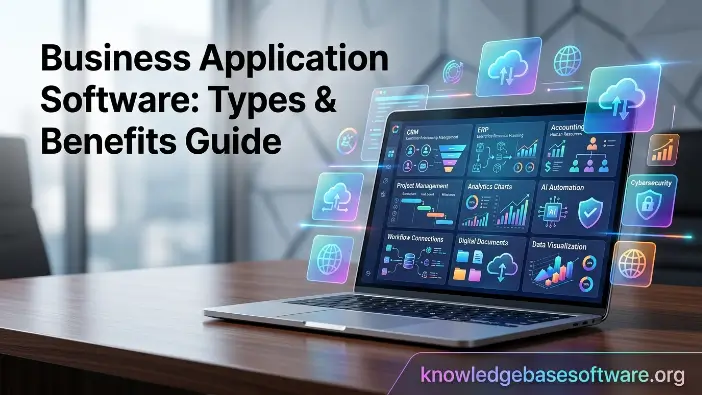
Business organizations depend on various categories of business application software to handle specific functions such as finance, sales, human resources, and operations. Each type addresses a particular business requirement, while working together to create an integrated digital ecosystem that increases efficiency, minimizes manual effort, and supports informed decision-making. Understanding these categories enables businesses to select suitable tools according to their goals, organizational size, and industry needs.
Enterprise Resource Planning (ERP) Systems
Enterprise Resource Planning (ERP) systems are comprehensive platforms that bring essential business processes together within one unified system. These solutions connect departments including finance, procurement, inventory, production, and operations, enabling real-time information sharing throughout the organization.
The primary purpose of ERP systems is to remove data silos and strengthen coordination between departments. Rather than depending on separate applications for different functions, ERP combines operations within a centralized database. This improves data accuracy, limits duplication, and increases overall productivity. Common ERP capabilities include financial management, supply chain coordination, reporting dashboards, and workflow automation. Large organizations frequently use ERP solutions to manage complex business activities more effectively.
Examples include widely adopted ERP systems such as SAP, Oracle ERP Cloud, and Microsoft Dynamics 365, which offer scalable solutions designed for organizations of different sizes.
Customer Relationship Management (CRM) Software
Customer Relationship Management (CRM) software helps businesses organize and manage interactions with existing and potential customers. Its main focus is improving customer satisfaction, supporting sales growth, and developing stronger long-term relationships.CRM systems maintain customer information such as contact details, purchase records, communication history, and preferences.
A major benefit of CRM tools is sales pipeline management, which enables businesses to follow leads from their first interaction through final conversion. These systems can also support marketing automation, customer service ticketing, and performance analysis. Popular CRM tools include Salesforce, HubSpot CRM, and Zoho CRM, which are used across many industries to manage customer relationships efficiently and support revenue growth.
Supply Chain Management (SCM) Software
Supply Chain Management (SCM) software helps organizations control the movement of products, services, and information from suppliers through to final customers. It helps ensure that goods move efficiently, arrive on schedule, and are managed at an appropriate cost.SCM systems allow businesses to monitor inventory, manage supplier relationships, improve logistics, and predict future demand. These capabilities are important for minimizing delays, preventing stock shortages, and maintaining customer satisfaction.
In sectors such as manufacturing, retail, and e-commerce, SCM software is essential for keeping operations running smoothly. It offers real-time supply chain visibility, allowing businesses to respond more effectively to shifts in demand, delivery issues, or supply disruptions.
Human Resource Management (HRM) Systems
Human Resource Management (HRM) systems manage a wide range of employee-related activities within an organization. These systems support functions such as recruitment, payroll, attendance monitoring, performance assessment, and employee record management.HRM software reduces manual paperwork and automates many repetitive administrative responsibilities. This increases efficiency while allowing HR teams to spend more time on strategic areas such as employee engagement and talent development.
Modern HR software solutions can also provide employee self-service portals, automated onboarding, and compliance management features. These capabilities help businesses maintain reliable employee information and meet regulatory requirements. By adopting HRM systems, organizations can improve workforce productivity, simplify recruitment procedures, and support stronger employee satisfaction.
Accounting & Finance Software
Accounting and finance software is important for handling a company’s financial operations, including budgeting, invoicing, expense management, tax preparation, and financial reporting. These systems keep financial information organized, accurate, and readily available. A major purpose of accounting software is to automate calculations and minimize errors caused by manual financial work. This helps businesses maintain reliable financial records while following applicable accounting standards.
These systems can also deliver real-time financial information through dashboards and reports, helping business owners make informed choices about cash flow, profitability, and budgets. Popular accounting software solutions include QuickBooks, Xero, and FreshBooks, which are widely used by small and medium-sized businesses to manage finances efficiently.
Key Features of Business Application Software
Business application software helps organizations simplify processes, increase operational efficiency, and support data-driven decisions across multiple departments. These systems offer a variety of useful features that allow companies to automate routine activities, connect operations, and manage information effectively. By combining flexibility, scalability, and modern technology, they help businesses maintain efficient operations in an increasingly competitive digital environment.
Key Features
- Automation of repetitive business activities to save time and minimize manual work
- Centralized data management for easier access and greater data accuracy
- Smooth integration with other business systems and third-party applications
- Real-time reporting and analytics to support informed decision-making
- Cloud-based access for remote work and more flexible business operations
- Strong data security and controlled user access
- Customizable workflows designed around individual business requirements
- Scalability to accommodate organizational growth and expansion
- Cross-department collaboration through shared digital platforms
- Backup and disaster recovery capabilities to safeguard important business information
Benefits of Using Business Application Software
Business application software is an important part of modern organizations because it enhances operational performance, simplifies workflows, and supports more informed decision-making. By bringing multiple business processes together within a connected system, it reduces manual effort and improves overall productivity. These benefits are particularly valuable in a competitive business environment, where business efficiency tools, workflow automation, and digital transformation continue to influence organizational growth and success.
Improved Efficiency and Productivity
A major benefit of business application software is its ability to increase efficiency and employee productivity. By automating repetitive activities such as data entry, reporting, and scheduling, employees have more time to concentrate on strategic and higher-value responsibilities. This reduces wasted time and helps business processes operate smoothly with fewer unnecessary delays.
In addition, workflow automation helps organizations standardize processes across different departments, reducing inconsistencies and supporting more reliable results. Consequently, businesses can complete more work in less time while maintaining better accuracy and consistent quality.
Better Decision Making with Data
Modern business application software gives organizations real-time access to organized and accurate information, which is essential for effective decision-making. Managers can review trends, track business performance, and create reports quickly, allowing them to react more efficiently to changing market conditions.
Through advanced analytics and interactive dashboards, companies can gain valuable insights into customer behavior, financial results, and operational performance. This data-driven approach reduces reliance on assumptions and supports more effective planning and strategy throughout the organization.
Cost Reduction
Cost reduction is another important benefit of business application software. Automating business processes and reducing the need for manual work can help organizations lower operating expenses. Minimizing errors caused by manual processes also reduces the need for expensive corrections and prevents avoidable inefficiencies.
In addition, cloud-based solutions can reduce the requirement for costly infrastructure and ongoing maintenance. This allows small and medium-sized businesses to access advanced software capabilities while supporting sustainable long-term financial management.
Enhanced Collaboration
Business application software strengthens communication and collaboration between departments by providing a centralized environment for sharing information and coordinating activities. Teams can work with the same up-to-date information, helping reduce misunderstandings and keeping workflows properly aligned.
This advantage is particularly useful for remote and hybrid workplaces, where digital transformation has increased the importance of effective collaboration technologies. Employees can coordinate tasks and share information from different locations, supporting faster project completion and stronger teamwork.
Scalability for Growing Businesses
Scalability is an important advantage of business application software, as it allows organizations to expand without significantly disrupting established processes. As companies grow, their software can be adapted to support additional users, larger workloads, and increasing amounts of data.
This flexibility means businesses do not necessarily need to replace their systems whenever they expand. Instead, they can upgrade existing solutions or add new capabilities to meet changing requirements, making continued growth easier to manage and more cost-effective.
Common Challenges and Solutions
Although business application software provides many advantages, organizations can encounter challenges during implementation and everyday use. Common difficulties include system setup, employee adoption, data migration, and integration with existing technology. With careful planning and the right strategy, however, these challenges can be addressed effectively. Recognizing potential problems early allows businesses to create a smoother digital transformation process and gain greater value from their software investment.
High Implementation Cost
A common challenge associated with business application software is the potentially high initial implementation cost. Expenses may include software licenses, infrastructure, customization, and deployment, which can place considerable pressure on the budgets of small and medium-sized organizations.
Solution
Businesses can lower these costs by selecting cloud-based or subscription-based solutions rather than making large upfront investments. Implementing essential modules first and expanding the system gradually can also make expenses easier to control.
Training Requirements
Employees generally need appropriate training before they can use new systems effectively. Without sufficient guidance, productivity can decline, and employees may have difficulty adjusting to unfamiliar workflows and processes.
Solution
Organizations should provide structured training programs, practical workshops, and clear user documentation. Ongoing learning resources and onboarding sessions can further improve user adoption and help employees become comfortable with the new system.
Integration Issues
Many organizations already depend on several software tools, so connecting new business application software with existing systems can be complicated. Weak integration can create data silos, duplicate information, and interruptions in established workflows.
Solution
Businesses should select software that offers reliable API support and broad compatibility with other platforms. Involving IT professionals early in the software selection and planning process can also help identify compatibility issues and support smoother integration.
Data Migration Challenges
Moving information from older systems into new software can be a complicated and sensitive process. Problems such as missing information, inconsistent records, or data corruption can occur if migration is not carefully managed.
Solution
Organizations should create a detailed data migration plan before transferring information. This should include reliable backups, phased testing, and validation checks to confirm data accuracy. Professional migration tools or specialist assistance can further minimize risks and support a successful transition.
Future Trends in Business Application Software
The future of business application software is being influenced by fast technological development, evolving workplace practices, and increasing demand for automation and data-based decision-making. As organizations continue advancing their digital transformation efforts, business systems are becoming more intelligent, adaptable, and interconnected. These emerging technologies are improving efficiency while also changing how organizations manage operations, compete in global markets, and create value for customers.
Future Trends
- Greater use of artificial intelligence (AI) for automation, forecasting, and predictive insights
- Continued growth of cloud-native and cloud-first business applications
- Wider adoption of low-code and no-code platforms for faster application development
- Increasing dependence on real-time data analytics and business intelligence solutions
- Broader adoption of mobile-first business application solutions
- Growing integration of machine learning to support smarter business decisions
- Stronger emphasis on cybersecurity and protection of sensitive business data
- Expansion of hyperautomation through the combination of AI, RPA, and workflow technologies
- Better interoperability and data exchange between different business platforms and systems
- Increasing demand for personalized software designed for specific industries and business requirements
Frequently Asked Questions
What is business application software used for?
Business application software is used to manage and automate core business processes such as accounting, customer management, human resources, inventory control, and reporting. It helps organizations improve efficiency, reduce manual work, and make better decisions using real-time data.
What are examples of business application software?
Common examples include ERP systems, CRM platforms, accounting tools, HR management systems, and supply chain management software. Popular tools include SAP, Salesforce, Oracle NetSuite, and QuickBooks.
Is ERP considered business application software?
Yes, ERP (Enterprise Resource Planning) is a major category of business application software. It integrates multiple business functions like finance, operations, and supply chain into one centralized system for better coordination and efficiency.
What is the difference between CRM and ERP software?
CRM software focuses on managing customer relationships, sales, and marketing activities. ERP software, on the other hand, manages overall business operations such as finance, inventory, and HR. Both serve different but complementary roles in a business.
Why is business application software important for modern businesses?
It is important because it improves productivity, reduces operational costs, enhances collaboration, and supports data-driven decision-making. It also enables businesses to scale efficiently and adapt to changing market conditions.
Conclusion
Business application software has become an essential foundation for modern organizations seeking efficiency, accuracy, and long-term growth. By integrating key business functions such as finance, customer management, human resources, and operations, it enables companies to streamline workflows and eliminate unnecessary manual processes. This leads to improved productivity and better coordination across all departments.
As businesses continue to embrace digital transformation, the role of business efficiency tools and workflow automation will only become more important. Companies that adopt advanced software solutions today will be better positioned to compete, scale, and adapt in an increasingly technology-driven market. Ultimately, investing in the right business application software is not just a technical decision it is a strategic move toward sustainable success.