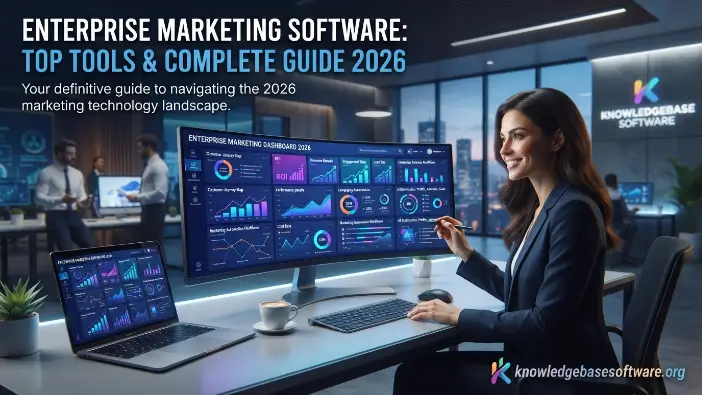
Welcome to knowledgebasesoftware. In today’s highly competitive digital landscape, enterprise marketing software has become a critical foundation for organizations that need to manage complex marketing operations at scale. Large businesses no longer rely on scattered tools or manual workflows; instead, they depend on integrated systems that unify data, automate campaigns, and deliver consistent customer experiences across multiple channels. At its core, enterprise marketing software enables companies to centralize their marketing automation platforms, customer data platforms (CDPs), and CRM systems into a single ecosystem. This integration allows marketing teams to better understand customer behavior, optimize campaigns in real time, and deliver highly personalized messaging at every stage of the customer journey.
As businesses grow, managing thousands or even millions of customer interactions becomes increasingly difficult without advanced marketing automation tools. That is why modern enterprises invest in solutions that provide scalability, omnichannel marketing capabilities, and AI-powered insights. These features help organizations move beyond basic campaign management and toward data-driven decision-making that improves ROI and customer retention. Ultimately, enterprise marketing software is not just a tool; it is a strategic infrastructure that supports digital transformation, enhances operational efficiency, and enables long-term business growth in a data-centric world.
What Is Enterprise Marketing Software?
Enterprise marketing software is a comprehensive suite of tools designed to help large organizations plan, execute, automate, and optimize marketing activities at scale. Unlike basic marketing applications, these platforms are built to handle high volumes of customer data, complex workflows, and multi-team collaboration across different regions, channels, and business units. They serve as the central nervous system of modern enterprise-level marketing operations.
Core Definition
At its core, enterprise marketing software is a centralized system that combines automation, analytics, customer data management, and campaign execution into one unified platform. It enables marketing teams to manage the entire customer journey from awareness and acquisition to conversion and retention without relying on disconnected tools.
In practice, these platforms function as advanced, scalable marketing software solutions that can grow alongside a business. Whether a company is handling thousands or millions of customers, the system ensures consistent performance, reliable data handling, and coordinated campaign execution across all touchpoints.
How It Differs from Standard Marketing Tools
Standard marketing tools are typically designed for small to mid-sized businesses and focus on single functions such as email marketing, social media scheduling, or basic analytics. While useful, they often lack integration and scalability.
In contrast, enterprise-grade solutions are built as enterprise SaaS marketing tools that provide:
- Deep integration with CRM and sales systems
- Advanced automation workflows across multiple channels
- Real-time analytics and predictive insights
- Multi-region and multi-brand campaign management
- Enterprise-level security, governance, and compliance
Another key difference is that enterprise platforms are designed as omnichannel marketing platforms, meaning they unify customer interactions across email, web, mobile apps, social media, and paid advertising into a single coordinated system.
Key Components of Enterprise Platforms
Most enterprise marketing platforms consist of several interconnected modules that work together to deliver end-to-end marketing capabilities:
- Customer Data Platform (CDP): Centralizes and unifies customer data from multiple sources into a single profile
- Marketing Automation Engine: Automates workflows such as email sequences, lead nurturing, and behavior-based triggers
- CRM Integration Layer: Connects marketing data with sales and customer support systems for a unified customer view
- Analytics and Reporting Dashboard: Provides real-time insights into campaign performance, ROI, and customer behavior
- Omnichannel Campaign Manager: Coordinates messaging across email, SMS, social media, web, and paid ads
Together, these components allow enterprises to deliver highly personalized and data-driven marketing experiences at scale while maintaining consistency across all customer touchpoints.
Read Also: marketing intelligence software
Key Features of Enterprise Marketing Software
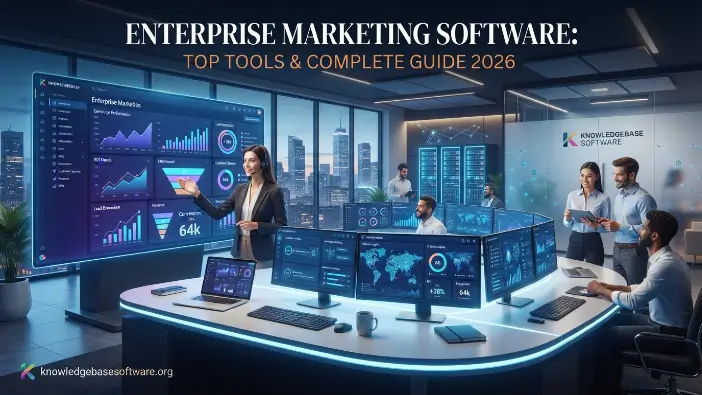
The power of enterprise marketing software lies in its ability to unify multiple advanced marketing capabilities into a single, scalable ecosystem. Instead of relying on separate tools for automation, analytics, and customer engagement, enterprises use integrated platforms that streamline operations, improve decision-making, and enhance customer experiences across every touchpoint. These systems are designed to support customer journey automation, data-driven insights, and large-scale campaign execution with precision and consistency. By combining intelligence, automation, and real-time data processing, enterprise marketing software helps organizations move beyond traditional marketing execution.
Marketing Automation
Marketing automation is one of the core pillars of enterprise marketing software, enabling businesses to automate repetitive tasks such as email campaigns, lead nurturing, and customer follow-ups. This ensures that marketing teams can focus more on strategy while the system handles execution based on predefined triggers and customer behavior.
For large organizations, automation is essential for scaling operations without sacrificing quality or consistency. With B2B marketing automation tools, enterprises can build complex workflows that respond dynamically to user actions, ensuring timely and relevant communication across the entire customer lifecycle.
Customer Data Management (CDP/CRM)
A strong enterprise marketing software platform includes robust customer data management capabilities through CDPs and CRM systems. These components collect, unify, and organize customer data from multiple sources, creating a single, accurate view of each customer.
This unified data structure allows marketing teams to better understand customer behavior, preferences, and engagement history. As a result, businesses can deliver more targeted campaigns and improve overall marketing efficiency by leveraging real-time insights from a centralized system.
AI-Powered Analytics
AI-powered analytics is transforming how enterprise marketing software interprets data and guides decision-making. Instead of relying solely on historical reports, AI systems analyze patterns, detect trends, and generate actionable insights in real time.
These capabilities enable businesses to forecast outcomes, optimize campaigns, and identify high-value customer segments more accurately. With predictive analytics marketing, organizations can anticipate customer behavior and adjust strategies proactively rather than reactively.
Multi-Channel Campaign Management
Multi-channel campaign management allows enterprise marketing software to coordinate marketing efforts across various platforms such as email, social media, mobile apps, and paid advertising. This ensures that messaging remains consistent and synchronized across all customer touchpoints.
By managing campaigns from a centralized system, businesses can avoid fragmented communication and deliver a seamless brand experience. This is especially important for large enterprises that operate across multiple regions and need unified control over global marketing strategies.
Personalization & Segmentation
Personalization and segmentation are essential features that make enterprise marketing software highly effective in modern digital marketing. These tools allow businesses to divide audiences into specific groups based on behavior, demographics, and engagement history.
Once segmented, marketing teams can deliver highly personalized content that resonates with individual users or specific customer groups. This level of precision significantly improves engagement rates, conversion performance, and long-term customer loyalty by ensuring every message feels relevant and timely.
Best Enterprise Marketing Software Tools
Choosing the right enterprise marketing software is one of the most important decisions for large organizations aiming to scale their marketing operations effectively. The market is filled with powerful solutions that offer automation, analytics, CRM integration, and omnichannel capabilities. Each platform has its own strengths, making it essential to evaluate them based on business size, technical requirements, and long-term goals. Many of these solutions are considered top marketing automation platforms because they combine advanced features with enterprise-grade scalability. Modern businesses rely on these systems as part of their broader digital ecosystem, often integrating them with other enterprise SaaS tools to create a unified marketing and sales infrastructure.
Salesforce Marketing Cloud
Salesforce Marketing Cloud is one of the most powerful enterprise marketing software solutions available today. It offers deep CRM integration, advanced customer journey mapping, and AI-driven insights through Salesforce Einstein. This platform is widely used by global enterprises to manage personalized campaigns across multiple channels.
As part of the broader ecosystem of marketing CRM software, Salesforce allows businesses to connect marketing, sales, and service data into a single unified system. Its scalability and flexibility make it a preferred choice for organizations that require highly customized and data-driven marketing strategies.
Adobe Experience Cloud
Adobe Experience Cloud is a comprehensive enterprise marketing software suite designed to deliver personalized digital experiences at scale. It combines analytics, content management, advertising, and commerce tools into one powerful ecosystem. This makes it particularly effective for brands focused on customer experience optimization.
Recognized as one of the leading marketing automation platforms, Adobe Experience Cloud enables enterprises to create consistent and engaging omnichannel experiences. Its strong focus on data analytics and content personalization helps businesses deliver highly targeted messaging across all digital touchpoints.
HubSpot Enterprise
HubSpot Enterprise is a scalable enterprise marketing software solution known for its user-friendly interface and powerful automation capabilities. It provides advanced CRM features, marketing automation workflows, and detailed reporting tools designed for growing enterprises.
As part of modern enterprise SaaS tools, HubSpot offers strong integration capabilities with third-party applications, making it a flexible option for businesses looking to unify their marketing stack. It is especially popular among organizations that want a balance between ease of use and enterprise-level functionality.
Oracle Marketing Cloud
Oracle Marketing Cloud is a data-driven enterprise marketing software platform that focuses heavily on customer intelligence and cross-channel marketing automation. It is designed for large organizations that handle complex datasets and require advanced segmentation and targeting.
As one of the more powerful marketing CRM software solutions, Oracle enables enterprises to build highly personalized campaigns using real-time data insights. Its strength lies in combining marketing automation with deep analytics for large-scale business environments.
SAP Marketing Cloud
SAP Marketing Cloud is a robust enterprise marketing software solution that integrates seamlessly with SAP’s broader business ecosystem. It is particularly effective for enterprises already using SAP ERP systems, allowing for smooth data flow across departments.
Positioned among leading enterprise SaaS tools, SAP Marketing Cloud focuses on delivering intelligent customer insights and automated marketing workflows. Its strong data foundation makes it ideal for organizations that prioritize operational efficiency and data consistency across global markets.
Benefits of Enterprise Marketing Software
The enterprise marketing software provides organizations with a powerful foundation to streamline marketing operations, improve decision-making, and scale campaigns efficiently across multiple channels. It enables businesses to unify data, automate processes, and deliver more personalized customer experiences. By leveraging advanced analytics and automation, companies can significantly enhance performance, reduce operational costs, and achieve consistent growth in competitive markets.
Benefits of Enterprise
- Improves marketing efficiency through automation, reducing manual tasks and enabling teams to focus on strategy and creative campaign development overall
- Enhances customer insights by consolidating data from multiple sources into a unified system for better decision-making and targeting accuracy
- Increases return on investment by optimizing campaigns using real-time analytics and performance tracking across all marketing channels and platforms continuously.
- Enables scalable campaign management, allowing businesses to execute thousands of campaigns simultaneously without losing consistency or operational control globally
- Strengthens customer engagement through personalized messaging based on behavior, preferences, and real-time interaction data collected across digital touchpoints, effectively
- Supports faster decision-making by providing AI-powered insights and predictive analytics that identify trends and future customer behavior patterns accurately
- Reduces marketing costs by eliminating redundant tools and integrating all functions into a single,e centralized, enterprise-level marketing platform efficiently
- Improves lead generation quality through advanced segmentation and targeting capabilities that identify high-value prospects across multiple marketing channels consistently
- Enhances collaboration between marketing, sales, and customer service teams by integrating CRM systems and shared customer data repositories seamlessly
- Ensures better brand consistency across all channels by centralizing campaign management and maintaining unified messaging across global markets
Challenges and Limitations
While enterprise marketing software offers powerful capabilities for scaling and optimizing marketing operations, it also comes with several challenges that organizations must carefully consider before implementation. These platforms are complex, resource-intensive, and require strategic planning to ensure successful adoption across teams. Many businesses underestimate the operational and technical demands, which can lead to inefficiencies if not properly managed. Common enterprise software challenges often revolve around cost, integration, and user adoption. In addition to technical barriers, organizations also face structural and operational limitations when deploying enterprise marketing software. These systems often require alignment across multiple departments, updated workflows, and long-term commitment to digital transformation.
High Implementation Cost
One of the biggest challenges of enterprise marketing software is its high implementation cost. These platforms often require significant investment in licensing, infrastructure, customization, and ongoing maintenance. For large organizations, the initial setup can be complex and financially demanding, especially when integrating multiple systems.
Beyond the initial cost, businesses must also consider long-term expenses such as training, support, and upgrades. Many enterprises underestimate the total cost of ownership, which includes not only software fees but also operational adjustments and resource allocation needed to maintain performance.
Complexity of Integration
Integration complexity is another major challenge when deploying enterprise marketing software. These platforms must connect with existing CRM systems, data warehouses, ERP tools, and third-party applications, which can create technical difficulties if systems are not compatible.
This level of integration often leads to SaaS integration issues, especially in organizations with outdated or fragmented technology stacks. Ensuring smooth data flow across platforms requires strong IT expertise, careful planning, and ongoing system monitoring to prevent disruptions.
Learning Curve for Teams
The learning curve associated with enterprise marketing software can be steep, particularly for teams transitioning from simpler tools. Employees often need extensive training to fully understand advanced features such as automation workflows, analytics dashboards, and AI-driven insights.
This challenge is closely linked to overall marketing stack complexity, where multiple interconnected systems require users to adapt to new processes and interfaces. Without proper onboarding and continuous training, businesses may struggle to fully utilize the platform’s capabilities, reducing its overall effectiveness.
How to Choose the Right Enterprise Marketing Software
Selecting the right enterprise marketing software is a strategic decision that directly impacts long-term marketing performance, operational efficiency, and business scalability. With so many platforms offering similar features, organizations must evaluate solutions based on their specific needs rather than popularity alone. A well-chosen system can unify marketing operations, improve customer engagement, and support sustainable growth across all digital channels. Without a clear selection strategy, companies risk investing in tools that do not align with their long-term objectives. To make the right choice, businesses should focus on core criteria such as business goals, technical compatibility, scalability, and cost structure.
Define Business Goals
Defining business goals is the first and most critical step in selecting enterprise marketing software. Organizations must clearly identify what they want to achieve, whether it is improving lead generation, increasing customer retention, or enhancing brand awareness across multiple markets.
When goals are clearly defined, it becomes easier to match platform capabilities with business needs. This alignment ensures that the chosen system supports key priorities and delivers measurable outcomes instead of unnecessary complexity or unused features.
Evaluate Integration Capabilities
Integration capabilities play a crucial role in determining the effectiveness of enterprise marketing software. The platform must seamlessly connect with existing systems such as CRM, ERP, analytics tools, and third-party marketing applications.
Strong integration ensures smooth data flow across departments, enabling a unified view of customer interactions. Poor integration, on the other hand, can lead to data silos, inefficiencies, and inconsistent reporting, which negatively impact marketing performance.
Check Scalability & Support
Scalability is essential when evaluating enterprise marketing software, especially for growing organizations. The platform should be able to handle increasing data volumes, expanding customer bases, and more complex campaign structures without performance issues.
Equally important is vendor support. Reliable technical assistance, regular updates, and training resources ensure that businesses can maximize the platform’s value over time. Without strong support, even powerful systems can become difficult to manage effectively.
Compare Pricing Models
Comparing pricing models is a key step in choosing enterprise marketing software, as costs can vary significantly depending on features, usage, and deployment structure. Some platforms charge based on user seats, while others use data volume or feature-based pricing.
Organizations must evaluate not only upfront costs but also long-term expenses such as customization, integration, and maintenance. A transparent pricing model helps businesses avoid hidden costs and ensures the solution remains financially sustainable as it scales.
Future of Enterprise Marketing Software
The future of enterprise marketing software is evolving rapidly as businesses increasingly adopt advanced technologies to improve customer engagement, automation, and data-driven decision-making. With the rise of artificial intelligence, machine learning, and real-time analytics, these platforms are becoming more intelligent, predictive, and highly personalized. Organizations are shifting toward fully integrated ecosystems that unify marketing, sales, and customer experience into a seamless digital journey. This transformation is reshaping how enterprises plan, execute, and optimize marketing strategies at scale.
Future of Enterprise
- AI-driven automation will optimize campaigns in real time, improving targeting accuracy and reducing manual marketing effort across enterprise systems
- Predictive analytics will help businesses forecast customer behavior, enabling proactive strategies and better decision-making in competitive markets globally.y
- Hyper-personalization will deliver tailored content experiences to individual users based on real-time data and behavioral insights across channels.
- Omnichannel integration will unify customer interactions across email, mobile, web, and social platforms into one seamless experience.
- Advanced data privacy tools will ensure compliance with global regulations while maintaining effective personalized marketing strategies for the enterprise.s
- No-code and low-code tools will empower marketers to build workflows without heavy technical dependency or developer involvement in processes.
- Real-time data processing will allow instant campaign optimization based on live user engagement and performance metrics across platforms.
- Cloud-native architectures will improve scalability, flexibility, and deployment speed for global enterprise marketing operations and distributed teams, efficiently.
- Integration of generative AI will automate content creation, improving speed and consistency across campaigns and marketing channels significantly .tly
- Customer journey intelligence will evolve, providing deeper insights into behavior patterns and optimizing end-to-end marketing performance continuously.
Frequently Asked Questions
What is enterprise marketing software used for?
Enterprise marketing software is used to manage, automate, and optimize large-scale marketing campaigns across multiple channels while improving customer engagement and data-driven decision-making.
How does enterprise marketing software differ from traditional tools?
Unlike traditional tools, enterprise marketing software integrates automation, analytics, CRM, and omnichannel capabilities into a single scalable platform for complex business needs.
Which companies use enterprise marketing software?
Large organizations in industries like finance, healthcare, retail, and SaaS use enterprise marketing software to handle high-volume customer interactions and global marketing operations.
Is enterprise marketing software expensive?
Yes, most enterprise marketing software solutions are costly due to advanced features, customization, integration requirements, and ongoing support and maintenance needs.
What are the main benefits of enterprise marketing software?
The main benefits include improved efficiency, better customer insights, automation of workflows, higher ROI, and scalable marketing campaign management across multiple channels.
Conclusion
In today’s competitive digital landscape, enterprise marketing software has become a vital foundation for organizations aiming to scale their marketing efforts efficiently and intelligently. By unifying automation, analytics, CRM integration, and omnichannel campaign management, these platforms enable businesses to deliver consistent and personalized customer experiences across every touchpoint.
As enterprises continue to adopt advanced technologies such as AI, predictive analytics, and real-time data processing, enterprise marketing software will play an even more critical role in driving growth and innovation. Companies that invest in the right solution today will be better positioned to improve ROI, streamline operations, and stay ahead in an increasingly data-driven marketplace.